How to Get More Referrals for Your Business
Most businesses get referrals by accident. A happy customer mentions you to a neighbor. A job goes well and someone passes your number along. It works — until it doesn’t. Here’s how to stop leaving it to chance.

Quick Answer: Ask within 48 hours of finishing a job. Build relationships with businesses that already talk to your customers — realtors, insurance agents, property managers. Give them a simple way to refer you and a reason to do it. That’s the system. The rest of this guide shows you how to build it and what to use.
If you’re reading this, one of two things is probably true.
Either referrals used to come in on their own and now they’ve slowed down. Or you’ve always known referrals should be a bigger part of your business and you just haven’t figured out how to make them consistent.
Either way, the problem is the same: referrals are happening by accident instead of by design.
A happy customer mentions you to their neighbor. A job goes well and someone passes your number along. It works — until it doesn’t, and you can’t figure out why it slowed down or how to turn it back on.
Referrals aren’t magic. They’re not something you wait for. The businesses that grow through referrals aren’t luckier than you — they just built a system around something most people leave to chance.
Here’s what that system looks like.
Why Referrals Dry Up (Even When Your Work Is Good)
The number one reason businesses don’t get enough referrals isn’t bad work. It’s bad timing.
Your customers think of you when they need you. But when their friend mentions a leaky roof three months after you fixed theirs, the connection doesn’t always happen fast enough. The moment passes. You don’t get the job.
The other reason: referring someone feels like a small risk. If you recommend a contractor and they do a bad job, that’s on you. Customers only refer when they’re confident enough to put their name behind you.
Once you understand both of those things — timing and confidence — the rest of this makes a lot more sense.
1. Just Ask — But Get the Timing Right
Most people never ask. That’s the whole problem.
Not because they’re too proud. Because they don’t know when to do it without feeling pushy.
The answer is simple: ask within 24-48 hours of finishing a job when the customer is happy and the experience is fresh. That’s the window. Ask too early and it feels presumptuous. Ask six months later and the moment is gone.
You don’t need a script. Something like:
“Glad it worked out. If you know anyone else who needs this, I’d love the intro — that’s honestly how I grow my business.”
That’s it. Honest, direct, not weird. Most customers are happy to help — they just needed to be asked.
2. Give People Something Worth Talking About
No referral system fixes average work. Before you think about tactics, think about what your customers actually say when they describe you.
It’s almost never “the best roofer I’ve ever seen.” It’s usually something small. “He showed up exactly when he said he would.” “She kept me updated the whole time.” “They left the place cleaner than they found it.”
Those specifics are what get passed along. Figure out what yours is and be consistent about it. That’s what turns a satisfied customer into someone who actually tells people about you.
3. Stop Relying Only on Your Customers
Customer referrals are great. They’re also slow and unpredictable.
Your customers only refer you when the topic comes up naturally. That might be once a year per person if you’re lucky.
Referral partners work differently. These are other businesses — ones that already talk to your ideal customers every single week — who can send you leads on purpose, consistently.
Think about it for your business:
- Roofer? Your best referral partners are realtors, insurance agents, and general contractors
- Plumber? HVAC companies, remodelers, property managers
- House cleaner? Real estate agents, move-in coordinators, home organizers
These people get asked “do you know a good contractor?” all the time. If your name is the first one that comes to mind — or better, if there’s a formal arrangement in place — those conversations turn into jobs.
One good referral partner is worth more than ten satisfied customers. The volume alone is different.
4. Make It Easy to Refer You
A lot of referrals die not because people don’t want to send them — but because it’s slightly too inconvenient.
They can’t remember your exact number. They’re not sure how to describe what you do. They meant to text their friend your name and just never got around to it.
The fix is dead simple. Give people:
- One sentence that describes what you do and where you work
- A direct link to your profile or booking page
- An easy way to pass you along — a text, a forward, a shareable link
Referring you should take 15 seconds, not 5 minutes. Every extra step you add is a referral you probably won’t get.
5. Pay for Referrals — It’s Not as Complicated as It Sounds
Customer referrals are free. Referral partner relationships are a business arrangement — and the best ones treat them that way.
When someone puts their name behind you, they’re taking a real reputational risk. Paying them a referral fee isn’t buying customers — it’s acknowledging that their trust and their relationship have value.
For home service businesses, the standard range is 5–15% of the job value. On a $10,000 roofing job, that’s $500–$1,500 for one introduction. For the person sending the referral, that adds up fast. For you, it’s still less than what you’d spend on ads for the same customer.
The structure matters though. A vague “I’ll take care of you” isn’t enough. You need a pre-agreed rate, a way to track who sent what, and a clear payment process when the job closes. Without that, even the best referral relationships eventually fall apart.
6. Use a Referral Marketplace to Skip the Hard Part
Building a referral partner network from scratch is slow. Finding the right contacts, reaching out cold, agreeing on terms, tracking who sent what, following up on payments — it’s a lot of overhead for a business that already has a full schedule.
Most people start with good intentions and let it fade within a few months because there’s nothing keeping it running.
That’s what a referral marketplace is for.
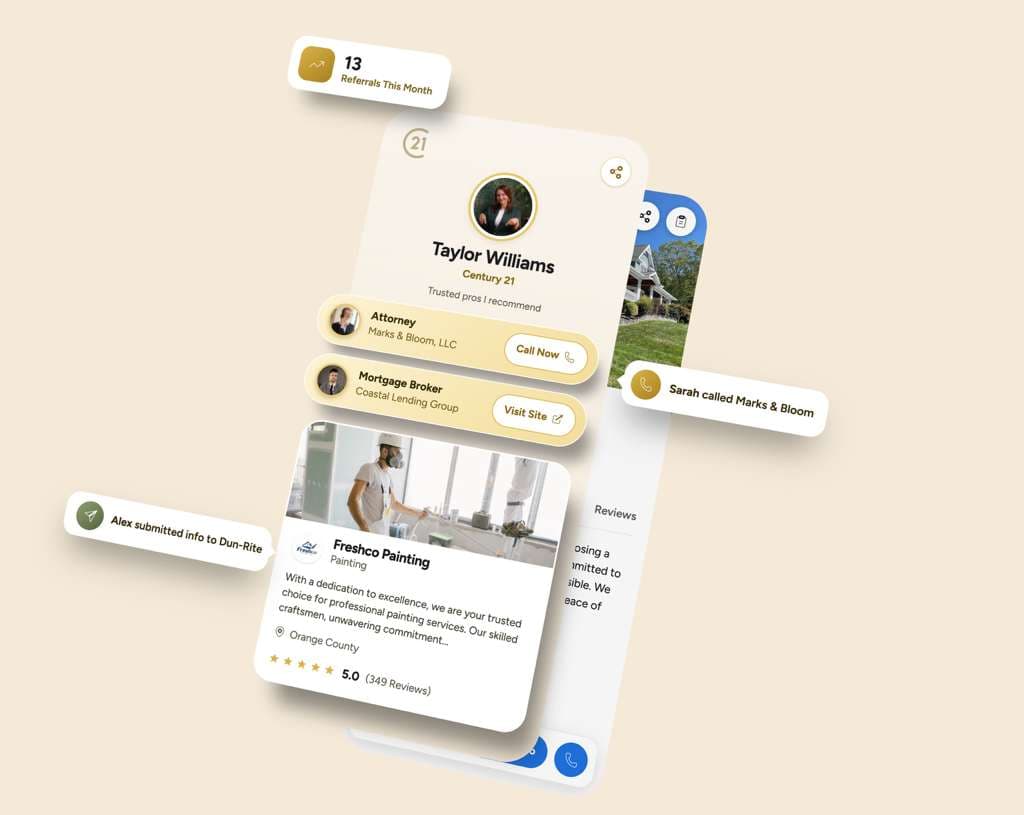
On ReferToday, you list your business with a pre-set commission rate. Realtors and other professionals in your area can find you, refer clients through their own personal link, and earn the commission automatically when a job closes. The tracking, the disclosure, and the payout all happen through the platform.
You don’t have to cold-call anyone. You don’t have to manage spreadsheets. You just show up, do good work, and pay out when a referral converts.
7. Close the Loop Every Single Time
When someone refers you, they’re watching what happens next.
Did you follow up quickly? Did you land the job? Was their friend happy? They might not say any of this out loud — but they’re paying attention. And their answer determines whether they refer you again or quietly stop.
Two things that cost nothing and make a real difference:
Update them. Even a short message. “Hey, I connected with your neighbor — we’re scheduled for Thursday.” That’s it. It closes the loop and shows you took it seriously (refertoday takes care of this for you).
Thank them specifically. Not a mass email. A real message that names what they did. For bigger jobs, a handwritten note or a gift card lands differently than you’d think. People remember it — and they refer you again.
What It Looks Like When It All Works
A service business with a real referral system looks like this:
- Every finished job ends with a quick, honest referral ask
- A few referral partners — realtors, insurance agents, complementary contractors — are sending leads regularly through a formal arrangement
- A listing on a referral marketplace makes it easy for new partners to find the business and start referring
- Every referral gets followed up on fast, tracked cleanly, and paid promptly
- Every referrer gets a genuine thank-you and an update
None of this is complicated. It’s five habits and the right tools. The businesses that do it aren’t special — they just stopped leaving referrals to chance.
Want referrals to be part of your business — not just a happy accident?
List your business on ReferToday. Set your referral rate. Get found by the realtors and professionals in your area who are already looking to refer clients to businesses like yours.
→List Your Business Free on ReferToday←
FAQ SECTION
What is the best way to get more referrals for a service business?
The most effective approach combines two strategies: asking satisfied customers directly at the right moment (within 48 hours of completing a job), and building formal referral partnerships with businesses that regularly interact with your target customers — such as realtors, insurance agents, or complementary contractors.
Should I pay people for referring my business?
Yes, for professional referral partners. A pre-agreed referral fee of 5–15% of the job value is standard for home service businesses. This makes the arrangement formal, trackable, and sustainable — and compensates partners fairly for the value they're creating.
How do I build a referral network for my service business?
Start by identifying businesses that serve the same customers you do but don't compete with you. For a roofer, that might be real estate agents or general contractors. Reach out directly to propose a referral arrangement, or list your business on a referral marketplace like ReferToday where partners can find you and refer clients through a personal affiliate link.
How many referrals should a small service business expect per month?
It varies significantly by industry and network size, but businesses with a formal referral system in place typically see 20–40% of new customers coming through referrals. A single strong referral partner can generate several jobs per month on its own.
What's the difference between a customer referral and a referral partner?
A customer referral happens organically when a happy client recommends you to a friend. A referral partner is a business or professional with a formal arrangement to send you clients consistently in exchange for a commission. Customer referrals are free but unpredictable. Referral partners are paid but scalable.